







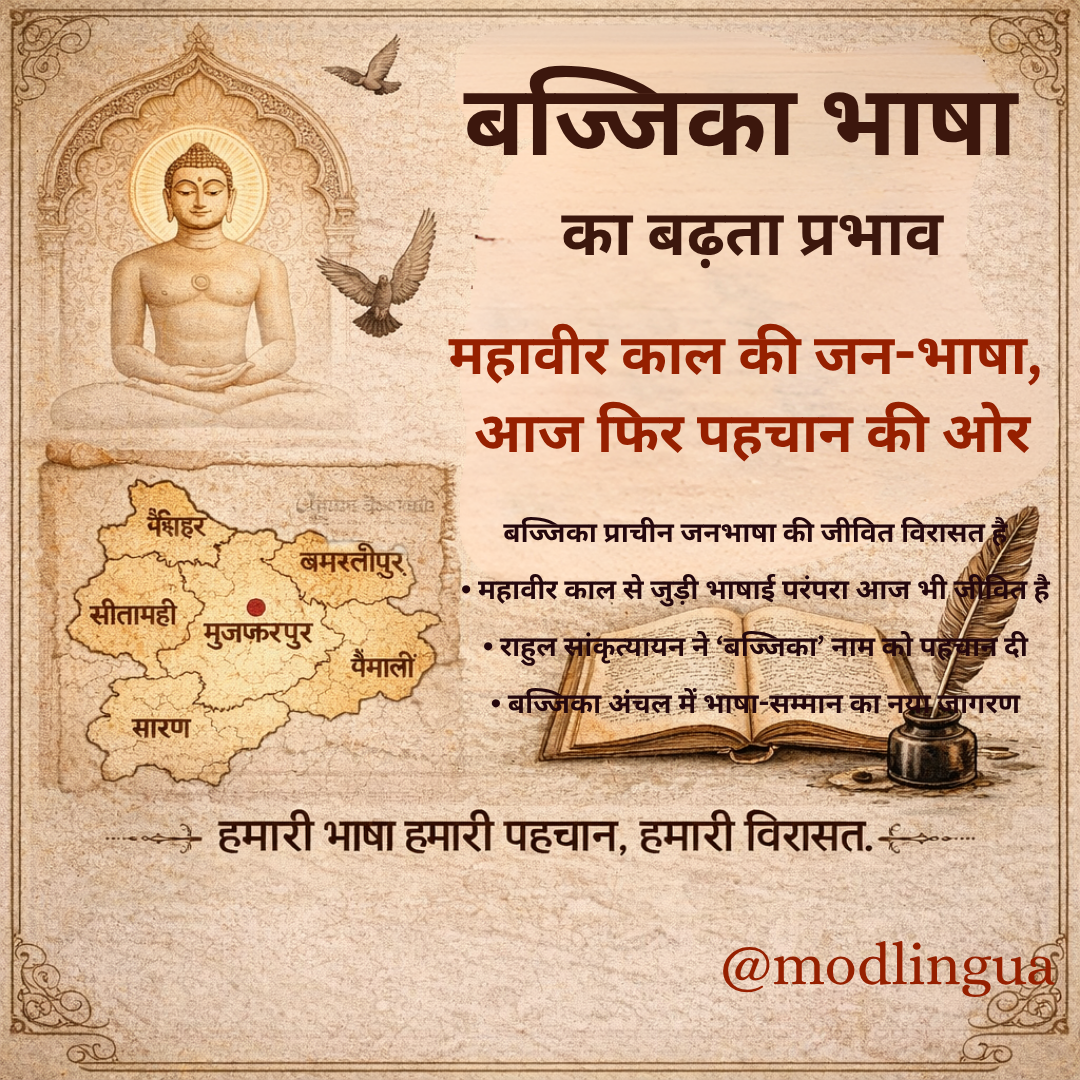
In a heartening cultural development from Muzaffarpur, a meaningful initiative has once again brought attention to the rich linguistic heritage of Bajjika, one of the oldest and most deeply rooted regional languages of Bihar.
A special programme was recently organized at Theosophical Lodge, Naya Tola, Muzaffarpur, under the banner of Bajjika Vikas Manch, where Mahavir Jayanti was observed as Bajjika Diwas. But this was not merely a ceremonial gathering. It carried a larger cultural message: that Bajjika is not just a spoken dialect of everyday life, but a language with deep historical roots, civilizational continuity, and emotional connection to the people of the region.
Speakers at the event stressed that the importance of Bajjika goes far beyond local identity. According to Uday Narayan Singh, Vice President of the Bajjika Vikas Manch, the language spoken in the Bajjika region during the time of Bhagwan Mahavir was Prakrit, which was then the common language of the people. He emphasized that present-day Bajjika is essentially a developed form of that same Prakrit tradition. This is a very important point, because it connects Bajjika not merely with regional usage, but with a long civilizational journey stretching back more than two thousand years.
That cultural continuity was echoed by several other speakers. Dr. Hari Kishore Prasad Singh noted that while the formal credit for the naming of the language as Bajjika goes to Pandit Rahul Sankrityayan, the language itself is far older and had already existed as a people’s language centuries before. In fact, it was pointed out that this linguistic tradition was alive even around 600 years before the Common Era, and continued as a jan-bhasha, a mass language, among ordinary people.
This distinction is crucial. A language may receive a formal name at a particular moment in history, but its lived existence often predates that recognition by centuries. That is exactly what makes Bajjika so significant. It was not artificially created. It grew naturally among the people. It lived in households, in local speech, in emotional vocabulary, in community memory, and in cultural expression.
Dr. Vinod Kumar Singh also underlined that although the naming of Bajjika as a linguistic identity came in 1936, its roots are much older, extending back to the periods associated with Mahavir and Buddha. In other words, Bajjika is not a recent linguistic assertion. It is an ancient voice that has survived through time.
In the presidential address, Chitranjan Sinha Kanak gave perhaps the most striking cultural description. He said that Bajjika is the daughter of Prakrit. He also referred to the meaning of Prakrit as something natural and unbound, and observed that such languages grow through life itself rather than rigid grammatical control. That expression gives emotional depth to the discussion: Bajjika is not merely a subject of scholarship, but a living inheritance.
Another important intervention came from Devesh Thakur, who said that until Bajjika finds a place in the Eighth Schedule, the movement for recognition should not rest. This reflects a growing consciousness in the region that preserving a language today requires both cultural pride and institutional support.
The presence of individuals such as Dr. Munna Gupta, Prem Kumar Verma, Rajesh Prasad Shahi, Ramesh Prasad Srivastava, Ashok Prasad Chaurasia, Sunita Soni, Anil Shankar Thakur, Dr. Usha Kiran, and others added further weight to the event. Their participation shows that the effort to protect Bajjika is no longer isolated. It is slowly becoming a wider cultural movement.
What makes this especially encouraging is the larger message behind such programmes. In a time when many regional languages struggle for space, dignity, and continuity, initiatives like these remind us that language is not just a tool of communication. It is identity, memory, history, and belonging.
And that is why this development from Muzaffarpur matters. It shows that people in the Bajjika region are becoming more aware, more organized, and more determined to preserve and promote their linguistic heritage. That awareness itself is a sign of revival.
Bajjika has survived because people carried it in their speech, their homes, and their everyday life. Now, with conscious efforts like these, it may also find the recognition it deserves in public and cultural discourse.
This is not just about remembering the past. It is about securing the future of a language that has lived for centuries and still continues to thrive.
